Shift planning software for hospitals, nursing homes and practices
The nursing roster that checks itself.
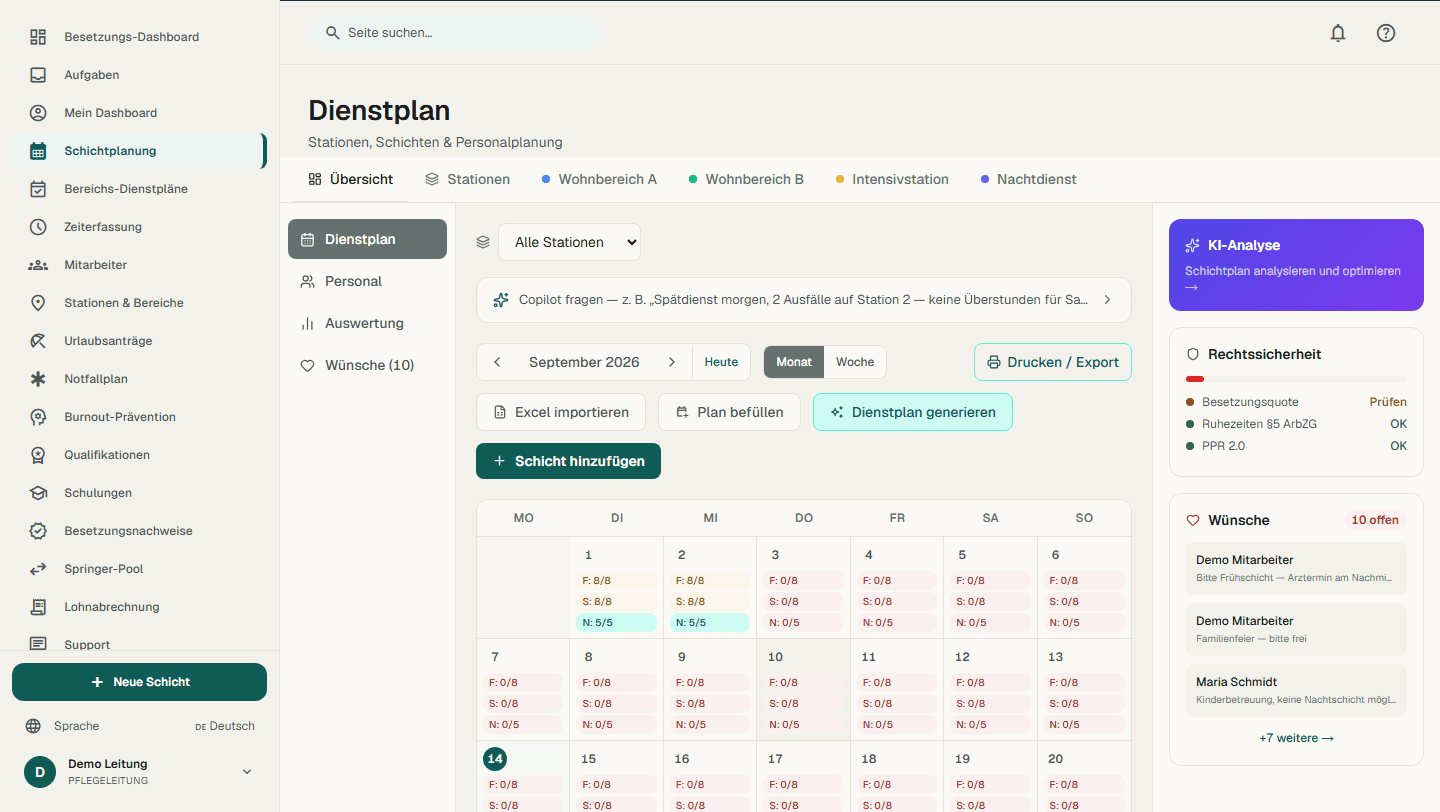
Rest periods, maximum working time and the qualified-staff ratio are checked while the roster is being built, not at the end of the month. When someone calls in sick, the cover is already there and already checked.
Automatic
monthly roster, built ahead of your deadline
~10 h
less admin per ward, per week
0
AI proposals that skip the legal check
- GDPR compliant
- Built for works-council review
- Redundant · two servers in Germany
- Encrypted in transit
- Phone support 6 a.m. – 9 p.m. CET
01·What it takes off your desk
Six things that cost a ward its time — and what Nurvo does with them.
Every line below is a real bottleneck from a German hospital or care home. Next to it is what the software actually does about it.
- A sick call at six in the morning
- Nurvo works out who can legally take the shift, notifies the team through the app and, if the ward cannot cover it internally, sends a structured request to the staffing agencies you have on file. The manager gets a finished proposal to approve.
- Days a month spent building the roster
- The system drafts the monthly roster ahead of your own deadline, within shift preferences, qualifications and statutory rest periods.
- The works council is wary of AI
- Nurvo proposes; it does not decide. Nothing is assessed about a person, every proposal is checked against working-time law and the collective agreement before it is shown, it is labelled under Article 50 of the EU AI Act, and a roster only takes effect when a manager approves it.
- Staffing records assembled by hand
- Required and actual staffing are calculated continuously, shortfalls are flagged as they happen, and the regulatory record exports as a PDF — under the PPBV for hospitals or § 113c SGB XI for nursing homes.
- Overload, and the turnover that follows it
- Nurvo tracks night shifts, overtime and shortened rest periods per person and signals a sustained build-up early, while a manager can still act on it.
- Time sheets on paper
- Staff clock in and out on their phone. Net hours, breaks, night hours and premiums are calculated to statutory requirements.
02·How it works
Planned before the problem exists.
The roster runs on its own. You only need a sentence from a manager when the automation meets a situation no rule covers.
- 1
Planned before the problem exists
Nurvo drafts the monthly roster for whatever lead time you set, within shift preferences, qualifications, statutory rest periods and the qualified-staff ratio that applies to your setting.
- 2
Absences absorbed in a set order
When someone calls in sick, the system works through the internal team, the float pool and then the external agencies you have on file. Everyone involved is notified in the app and by email.
- 3
A copilot for the cases no rule covers
For the unusual situations, a manager describes the need in plain language. Every proposal still runs the full check against working-time law, the collective agreement and the qualified-staff ratio before it appears.
03·Absence autopilot
When someone drops out, the cascade runs — with nobody on the phone.
Standby, float pool, partner agency: three stages in that order, every assignment checked against working-time law and the qualified-staff ratio before it is made.
1. Standby rota (internal)
First: the ward's own on-call staff
2. Available float pool
Second: colleagues with spare capacity
3. External staffing agencies
Third: agency and contract staff
04·AI copilot for short-notice situations
The ordinary case runs by itself. For the rest, one sentence is enough.
Describe an unforeseen staffing need in plain language. The copilot finds suitable cover and checks every proposal against the Working Hours Act, the collective agreement and qualified-staff ratios before it appears.
- 1
Describe the situation
Type what happened as free text. The system extracts the date, shift type, ward and constraints and summarises the request for review.
- 2
Get proposals with reasons
The copilot finds suitable people from the team using working-time accounts, qualifications and availability, and explains why it picked each one.
- 3
Every proposal is checked first
Before anything appears it is checked against §§ 3 and 5 of the German Working Hours Act, the collective agreement, qualified-staff ratios and existing absences.
05·What it saves
Around ten hours of admin per ward, per week.
The figures are our own estimate for a ward of roughly 25 people, not a customer average. They are here so you can check them against your own numbers, not so you take them on trust.
| Task, per ward and week | By hand | With Nurvo | Saved |
|---|---|---|---|
| Building the roster | 2.5 h | 0.25 h | 2.25 h |
| Absence and float cover | 2.75 h | 0.5 h | 2.25 h |
| Time tracking | 2.5 h | 0.5 h | 2.0 h |
| Payroll preparation | 1.25 h | 0.25 h | 1.0 h |
| Leave and shift preferences | 3.0 h | 0.75 h | 2.25 h |
| Staffing records | 1.0 h | 0.25 h | 0.75 h |
Want the calculation for your own ward? See what it costs.
06·Transparent pricing
One model per size of organisation.
Medical practices pay per member of staff, hospitals and care homes pay per ward — both include onboarding and support. Before either, the pilot: 10 to 12 weeks for 1,000 € net, credited in full if you go ahead.
Rostering, absence cover, time tracking and payslips — without the record modules a practice is not subject to.
See pricingUnlimited staff per ward, including the statutory staffing record under the PPBV or § 113c SGB XI.
For hospitals and care homesAll features, the pilot and the waiting list are on the pricing page.
07·Asked first, every time
The questions we get before anything else.
How much work is it to set up?
Staff are created with a personal invitation code, and a setup assistant walks you through building the first roster. During the pilot we do the initial setup and the data migration with you.
Does the AI decide the roster on its own?
No. The system produces proposals, and each one is checked automatically against the German Working Hours Act, the collective agreement and the qualified-staff ratio before it is shown. Under Article 50 of the EU AI Act every proposal is labelled. A roster takes effect only when an authorised manager explicitly approves it.
Where is our data stored?
On two redundant servers in Germany (Frankfurt am Main), fully GDPR compliant. Particularly sensitive details such as bank accounts stay only on the member of staff's own device.
Is Nurvo available in English?
The application is, in seven languages — German, English, Turkish, Polish, Romanian, Arabic and Russian — which matters because care teams in Germany are multilingual. The regulatory records and the legal pages are in German, because the rules they document are German.
Can we cancel?
The pilot runs for 10 to 12 weeks across two or three wards for a flat 1,000 € net. If you go ahead afterwards, that amount is credited in full against the annual contract. The annual contract then renews for twelve months at a time and can be terminated with three months' notice to the end of the term.
Something not answered here? All questions and answers · Security and works-council review · German staffing rules explained
See Nurvo with your own wards
We set up an account with realistic sample data and walk through it with you.
Already have an account? Sign in